Explainer · Bomerang.io
Hermes agent explained: how it works in 2026
By Nick Mayer · Updated
In 2026, small teams still lose hours to briefs, research, follow ups and rebuilding context. AI agents promise to take that load off, and Hermes, the open project from Nous Research, comes up again and again once the conversation gets serious.
Short answer
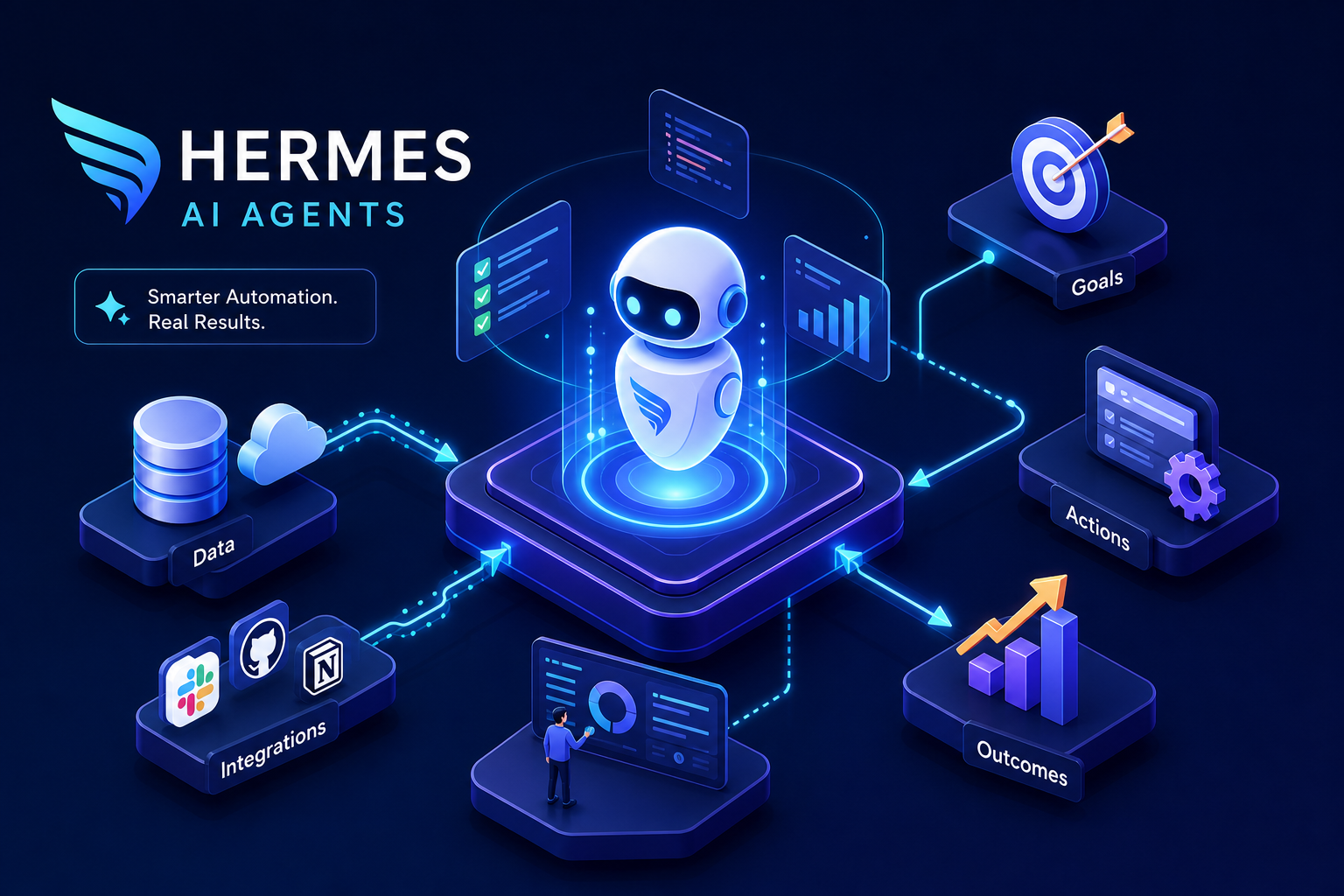
Hermes Agent is an open source AI agent that remembers context between sessions, learns reusable skills and can route work to different AI models. The software is free; what you pay for is hosting, model usage and the time to set it up and keep it running.
What is Hermes Agent and who built it?
Hermes Agent is an open source project from Nous Research. Its value is not just that it is free to use. Technical teams can inspect it, adapt it and run it on their own infrastructure.
That openness matters for teams that need control over data, memory and behavior. It is not a black box: you can see how it learns, how it loads instructions and how it decides which model to use.
How is it different from a standard chatbot?
A chatbot answers and forgets. Hermes keeps context between sessions, builds a picture of how you work and runs tasks with several steps with much less human supervision.
That is the practical difference: a chatbot helps, an agent acts, learns and does better on the next try. That matters a lot when the work spans content, SEO, nurturing leads and coordinating across tools.
How we use it: in Hermes Business OS we use this logic so AI does not stop at a nice conversation. It understands context, runs the steps and leaves a trail your team can review.
The architecture that makes Hermes persistent
Hermes combines persistent memory, skill documents and support for multiple models. Memory stores what it learned across sessions, skills teach it specific workflows, and routing lets it pick the right model for cost, speed or reasoning.
In practice, the agent can remember your brand voice, formatting preferences, business goals and team conventions without you repeating them every session. When context grows, Hermes prioritizes and consolidates what matters instead of simply forgetting. That is what makes it useful for repetitive work.
Persistent memory: what it keeps and why it matters
Hermes keeps two kinds of curated memory: one for notes about the environment and the project, and another for the user's preferences and profile. Both are loaded at the start of every session, so the agent starts with real context.
For content and sales teams, that means no more explaining your brand voice, customer segments, delivery format or priority keywords over and over. Less friction, more consistency.
Skills and closed loop learning
Hermes skills are instruction documents that teach specific workflows. The agent first loads a skill's name and description, and only pulls in the rest when it needs it.
Learning does not depend on retraining the model. It comes from capturing what worked in memory and in skills, which is why the agent gets more useful the more you use it.
Multiple models and routing
Hermes is provider agnostic. It can work with OpenRouter, Nous Portal, OpenAI, Hugging Face or local endpoints like Ollama. Switching models can be as simple as running one configuration command.
That matters if you want a cheap model for routine tasks and a stronger one for reasoning or delicate steps. The agent's logic stays separate from the model layer.
How much does a Hermes agent cost to run?
The Hermes software itself is open source and free. The running costs are the server it lives on, the AI model usage it consumes and the time someone spends configuring, connecting and maintaining it.
Model usage depends heavily on which models you route to and how much work the agent does, so it is worth starting with a cheaper model for routine tasks and measuring before you scale. If you would rather not manage any of it, a managed setup bundles hosting, configuration and upkeep into one service.
Quick comparison: Hermes, AutoGPT and BabyAGI
| Hermes | AutoGPT | BabyAGI | |
|---|---|---|---|
| Capabilities | Persistent memory, a skills library, integrations and routing across models. | Strong autonomous task breakdown, but less focused on long term memory by default. | A lightweight base for building flows rather than a production ready assistant. |
| Persistence | Memory across sessions and a user profile that improves over time. | Basic memory that depends more on how the project is configured. | A vector store or intermediate results, without a strong design for continuity. |
| Best fit | Teams that want an agent that learns and follows rules. | Chains of autonomous tasks with a familiar interface. | A starting point for developers. |
What you need to install it yourself
Hermes runs on Linux, macOS and WSL2. For a serious setup, plan on Python 3.11, Node 22 and at least 2 GB of RAM for the basics, with more memory if you will use a browser, tools or local inference.
The usual install path is simple: install the dependencies, run the post install step and then configure the provider, model and tools with the setup wizard. That is reasonable for technical teams. Business teams that want speed often prefer a managed option.
Where Bomerang fits
For a team that wants results without managing infrastructure, Bomerang offers two paths. A managed Hermes agent is set up, hosted and monitored for you around your own work. Hermes Business OS brings the same approach to a whole operation: sales, support, content and internal coordination, with approvals built in.
The goal is not to replace your team but to free up time and keep a clear record of what the agent did. Once AI is connected to the tools you actually use, it stops being an experiment and becomes part of the system.
The short conclusion
Hermes is not just another chatbot. It is a persistent, modular agent built for real workflows. Its mix of memory, skills and model routing makes it useful for teams that want to automate real work, not just try AI.
If you are a technical team, Hermes is a powerful foundation. If you want the same approach without the infrastructure work, a managed setup is the practical way to bring it into your daily operation.
Frequently asked questions
Is Hermes Agent free?
Yes, Hermes Agent is open source. You still pay for the server it runs on and for the AI model usage it consumes, plus the time to set it up and maintain it, or a managed service that does that for you.
Do I need to be technical to use Hermes?
To install and run it yourself, some technical comfort helps: a Linux, macOS or WSL2 environment, Python and Node, and configuring model providers. If you are not technical, a managed Hermes agent gives you the result without the setup.
Which AI models can Hermes use?
Hermes is provider agnostic. It can work with OpenRouter, Nous Portal, OpenAI, Hugging Face or local models through Ollama, and you can route routine tasks to a cheaper model and harder ones to a stronger model.
Next step
Want this approach in your operation? We can help you put it to work.